
FHA vs. Conventional Loans: Pros, Cons and Key Differences
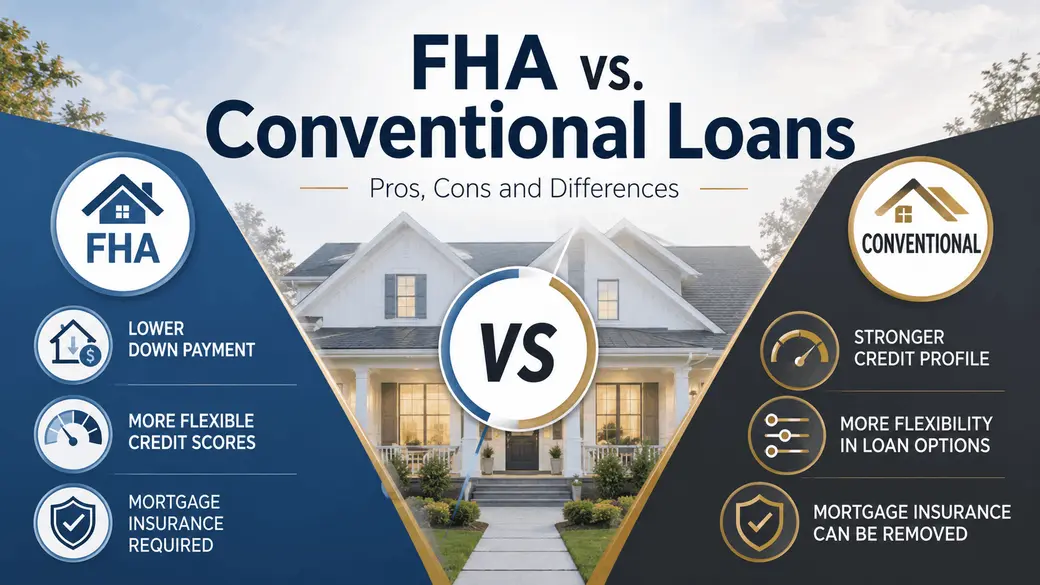
Choosing the right mortgage is one of the most important decisions you will make when buying a home. Two of the most common options are FHA loans and conventional loans, but each comes with different qualification standards, costs and long-term considerations.
An FHA loan may be attractive to buyers with limited savings or less-than-perfect credit. A conventional loan may offer lower long-term costs for buyers with stronger credit and a larger down payment.
Understanding the differences can help you decide which option better fits your financial situation and homeownership goals.
What Is an FHA Loan?
An FHA loan is a mortgage issued by a private lender and insured by the Federal Housing Administration, which is part of the U.S. Department of Housing and Urban Development.
Because the federal government insures the loan, lenders may be willing to approve borrowers with lower credit scores, smaller down payments or more limited credit histories. FHA loans can allow down payments as low as 3.5%, depending on the borrower’s qualifications. (HUD)
FHA loans are not limited to first-time homebuyers, although they are often popular with people purchasing their first home.
What Is a Conventional Loan?
A conventional loan is a mortgage that is not insured or guaranteed by a federal government agency. These loans are generally offered by banks, credit unions and mortgage lenders.
Some conventional loans conform to standards established by Fannie Mae and Freddie Mac, while others are classified as non-conforming loans.
Conventional loans may have stricter qualification requirements, but they can provide more flexibility and lower borrowing costs for well-qualified buyers.
FHA vs. Conventional Loans at a Glance
| Feature | FHA Loan | Conventional Loan |
|---|---|---|
| Government backing | Insured by the FHA | Not government-insured |
| Minimum down payment | As low as 3.5% | Some programs allow a low down payment |
| Credit requirements | Generally more flexible | Typically favors stronger credit |
| Mortgage insurance | Required on FHA loans | Usually required with less than 20% down |
| Property standards | Must satisfy FHA requirements | Generally fewer government-specific requirements |
| Loan limits | FHA limits vary by county | Conforming limits apply to many conventional loans |
| Primary residence | Generally required | May be available for primary homes, second homes and investment properties |
| Best suited for | Buyers with limited savings or credit challenges | Buyers with stronger credit or more savings |
Specific requirements vary by lender, loan program, property and borrower profile.
Advantages of an FHA Loan
Lower down-payment requirement
One of the biggest benefits of an FHA loan is the ability to purchase a home with as little as 3.5% down for qualifying borrowers. This can make homeownership more accessible for buyers who have enough income to handle a mortgage but have not saved a large down payment.
More flexible credit qualifications
FHA underwriting guidelines may accommodate lower credit scores than many conventional programs. That does not guarantee approval, but it may give buyers with past credit challenges another path to financing.
Potentially competitive financing for lower-credit borrowers
For a buyer with a lower credit score or a small down payment, an FHA loan may sometimes be less expensive than a comparable conventional option. The actual cost will depend on the lender, current interest rates and the borrower’s complete financial profile.
Gift funds may help with upfront costs
Depending on program and lender rules, eligible gift funds may be used toward the down payment or closing costs. This can be helpful for buyers receiving assistance from family members or other approved sources.
Disadvantages of an FHA Loan
Mortgage insurance is required
FHA loans require mortgage insurance. This generally includes an upfront mortgage insurance premium and an ongoing annual premium that is divided across the monthly mortgage payments.
For many FHA borrowers who make a down payment of less than 10%, monthly mortgage insurance can remain for the life of the loan. Borrowers who put at least 10% down may generally pay it for 11 years, subject to the applicable FHA rules.
Property requirements may be stricter
The property must satisfy FHA standards related to safety, structural soundness and livability. Certain conditions may need to be repaired before the loan can close.
This does not mean a home must be perfect, but an FHA appraisal involves more than determining market value.
Loan limits vary by location
FHA loans are subject to maximum loan amounts that vary by county. Buyers purchasing a more expensive property may find that the FHA limit does not cover the amount they need.
FHA financing may be less attractive in some transactions
In a competitive market, some sellers may prefer conventional financing because they expect fewer property-condition requirements or a more straightforward appraisal process. Every offer is different, however, and a well-qualified FHA buyer can still present a strong offer.
Advantages of a Conventional Loan
Mortgage insurance may be removable
Conventional borrowers who put down less than 20% may be required to pay private mortgage insurance, commonly called PMI. Unlike FHA mortgage insurance on many loans, conventional PMI is not necessarily permanent.
Depending on the loan and applicable requirements, the homeowner may be able to request cancellation after building sufficient equity. Automatic termination may also apply once certain conditions are met.
Potentially lower long-term costs
Borrowers with strong credit and a larger down payment may receive more favorable conventional pricing and avoid or eventually remove mortgage insurance.
The CFPB notes that FHA financing can be more expensive than conventional financing for some borrowers with good credit and a medium-sized down payment.
Greater property flexibility
Conventional financing may be available for primary residences, second homes and investment properties, depending on the program.
Conventional appraisals still examine value and property condition, but they do not use the same FHA-specific property standards.
Stronger appeal in competitive markets
Some sellers and listing agents may view conventional financing favorably, particularly when comparing similar offers. The strength of an offer also depends on the down payment, contingencies, closing timeline and the buyer’s overall financial approval.
Disadvantages of a Conventional Loan
Qualification may be more demanding
Conventional loans often favor borrowers with stronger credit, stable income and manageable debt. Buyers with lower credit scores may face higher interest rates, higher PMI costs or difficulty qualifying.
Interest rates are more sensitive to credit
Credit score, down payment, debt-to-income ratio and other risk factors can have a significant effect on conventional loan pricing.
Two buyers requesting the same loan amount may receive very different terms based on their financial profiles.
PMI may be required with a small down payment
A 20% down payment is not always required for a conventional mortgage. However, buyers putting down less than 20% will commonly need private mortgage insurance.
Cash requirements may be higher
Although low-down-payment conventional programs exist, some buyers may need more money upfront to receive favorable pricing or qualify for the home they want.
Which Loan Is Better?
Neither loan is automatically better for every buyer.
An FHA loan may be worth considering when:
-
Your credit needs improvement.
-
You have limited money available for a down payment.
-
You can comfortably afford the payment but have had difficulty meeting conventional requirements.
-
FHA pricing produces a better overall offer based on your qualifications.
A conventional loan may be a better fit when:
-
You have good or excellent credit.
-
You can make a larger down payment.
-
You want the possibility of eliminating mortgage insurance.
-
You are purchasing a second home or investment property.
-
You want to minimize your long-term borrowing costs.
The loan with the lowest advertised interest rate is not necessarily the least expensive option. Mortgage insurance, lender fees, closing costs and the length of time you expect to own the property should all be considered.
Compare the Total Cost, Not Just the Monthly Payment
Before choosing a mortgage, ask a lender to prepare comparable FHA and conventional scenarios using the same purchase price, down payment and estimated closing date.
Compare the following:
-
Interest rate and annual percentage rate
-
Principal-and-interest payment
-
Monthly mortgage insurance
-
Upfront mortgage insurance or PMI costs
-
Estimated cash needed at closing
-
Lender fees and discount points
-
Total cost over the first five or seven years
-
Whether and when mortgage insurance can be removed
The Consumer Financial Protection Bureau recommends requesting Loan Estimates from multiple lenders so you can compare the official terms and costs before making a final decision.
The Bottom Line
FHA loans can make homeownership more accessible by offering a lower down-payment option and more flexible qualification standards. The tradeoff is mandatory mortgage insurance and additional FHA property requirements.
Conventional loans may require stronger financial qualifications, but they can offer greater flexibility, removable mortgage insurance, and potentially lower long-term costs.
The best choice depends on your credit, savings, debt, target property and future plans. A knowledgeable lender can run both options, while an experienced real estate professional can help you understand how the financing may affect your home search and offer strategy.
This article is for general educational purposes and is not financial, lending, tax, or legal advice. Mortgage programs and qualification requirements can change and may vary by lender and borrower.


Leave a reply